My Blog List
-
The hills to die on7 years ago
-
The Existential Files9 years ago
-
-
Buddhist Healing Practice10 years ago
-
All About Tig Welders for Sale14 years ago



Web Counter




Sunday, December 20, 2009

Saturday, December 19, 2009
Atheists Love Christmas Too!
• http://www.youtube.com/zombiechaddy
Ever wonder where we get our Christmas traditions? This video explains where the most popular Christmas traditions come from.
Christmas is an annual holiday, celebrated on December 25, that commemorates the birth of Jesus of Nazareth.
The date of commemoration is not known to be Jesus' actual birthday, and may have initially been chosen to correspond with either the day exactly nine months after some early Christians believed Jesus had been conceived, a historical Roman festival, or the winter solstice.
Christmas is central to the Christmas and holiday season, and in Christianity marks the beginning of the larger season of Christmastide, which lasts twelve days.
For many centuries, Christian writers accepted that Christmas was the actual date on which Jesus was born. However, in the early eighteenth century, scholars began proposing alternative explanations.
Isaac Newton argued that the date of Christmas was selected to correspond with the winter solstice, which in ancient times was marked on December 25. In 1743, German Protestant Paul Ernst Jablonski argued Christmas was placed on December 25 to correspond with the Roman solar holiday Dies Natalis Solis Invicti and was therefore a "paganization" that debased the true church.
In 1889, Louis Duchesne suggested that the date of Christmas was calculated as nine months after the Annunciation (March 25), the traditional date of the Incarnation.
Although a Christian holiday, Christmas is widely celebrated by many non-Christians, and some of its popular celebratory customs have pre-Christian or secular themes and origins. Popular modern customs of the holiday include gift-giving, music, an exchange of greeting cards, church celebrations, a special meal, and the display of various decorations; including Christmas trees, lights, garlands, mistletoe, nativity scenes, and holly.
In addition, Father Christmas (known as Santa Claus in some areas, including North America, Australia and Ireland) is a popular mythological figure in many countries, associated with the bringing of gifts for children.
Because gift-giving and many other aspects of the Christmas festival involve heightened economic activity among both Christians and non-Christians, the holiday has become a significant event and a key sales period for retailers and businesses. The economic impact of Christmas is a factor that has grown steadily over the past few centuries in many regions of the world.
• http://en.wikipedia.org/wiki/Christmas
Monday, December 14, 2009
Mary and Isis
Black Virgins.... and a sun-god....
Wednesday, December 9, 2009
The TRUTH about Religion
Why the insanity of modern religion must end now.
Saturday, November 28, 2009
Christ Bowl found in Egypt describes magician
http://www.msnbc.msn.com/id/26972493/?GT1=43001
http://dsc.discovery.com/news/2008/10/01/jesus-bowl.html
Sunday, November 8, 2009
The Secret of Christianity REVEALED
Wednesday, November 4, 2009
Human rights ruling against classroom crucifixes angers Italy
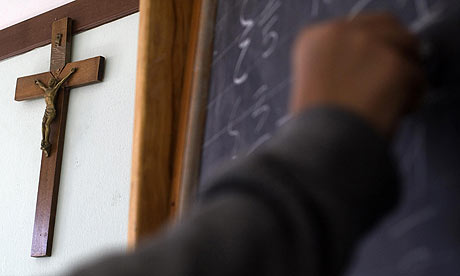
There was uproar in Italy today over a ruling by the European court of human rights that the crucifixes that hang in most Italian classrooms are a violation of religious and educational freedoms.
The seven judges, whose decision could prompt a Europe-wide review of the use of religious symbols on public premises, said state schools had to "observe confessional neutrality".
Except on the far left, the ruling met with condemnation among Italian politicians and was denounced by the Vatican. Silvio Berlusconi's education minister, Maria Stella Gelmini, said: "No one, not even some ideologically motivated European court, will succeed in rubbing out our identity."
A Vatican spokesman, Federico Lombardi, said the crucifix was a fundamental sign of the importance of religious values in Italian history and culture, and was a symbol of unity and welcoming for all of humanity, not one of exclusion.
A European court had no right intervening in such a profoundly Italian matter, he said, adding: "It seems as if the court wanted to ignore the role of Christianity in forming Europe's identity, which was and remains essential."
The ruling marked the end of an eight-year battle by a Finnish-born mother, Soile Lautsi. She took her cause to court after failing to get crucifixes removed from the school at which her two children were being taught at a town in north-east Italy.
Lautsi appealed to Strasbourg three years ago when her case was thrown out by Italy's constitutional court.
Although more than 7% of Italy's population is now of immigrant origin, multiculturalism has made few inroads and most Italians argue passionately, as did their government's advocate in Strasbourg, that the crucifix is a symbol of national identity.
The court disagreed. "The presence of the crucifix could easily be interpreted by pupils of all ages as a religious sign, and they would feel that they were being educated in a school environment bearing the stamp of a given religion," it ruled, ordering the Italian state to pay Lautsi €5,000 (£4,476) in damages.
Classroom crucifixes were made compulsory by two laws in the 1920s when Italy was a fascist state.
They have been applied less rigorously since 1984, when Catholicism ceased to be the state religion.
One government minister, Roberto Calderoli, of the Northern League, said yesterday: "The European court has trodden on our rights, our culture, our history, our traditions and our values."
Claudio Scajola, a member of Berlusconi's Freedom People party, said: "The crucifix is a universal symbol of love, meekness and peace. Preventing it from being displayed is an act of violence against the deep-seated feelings of the Italian people and all persons of goodwill."
The mayor of Rome, Gianni Alemanno, said he was flabbergasted. And the new, ex-communist leader of Italy's biggest opposition group, the Democratic party, Pierluigi Bersani, protested: "An ancient tradition like the crucifix cannot be offensive to anyone."
On the Facebook website, 23,000 people signed up to two pages opposed to the court's decision within hours of the news breaking.
The government's lawyer said he would seek leave to appeal to the Strasbourg court's 17-member Grand Chamber. If his petition is rejected, or if an appeal is subsequently thrown out, then Italy would be obliged to comply.
-from guardian.co.uk
Tuesday, November 3, 2009
Catholic Pope claims to be God 666
This video shows us the Pagan practices of the Roman Catholic Church. Other Christians, such as Protestants, Baptists, etc. might not practice the same pagan rituals or idolatry but they're all practically the same. They all worship the same God, believe in the holy trinity, they read the same bible (it doesn't really matter what version), and believe in Jesus Christ whose story is nothing more but a myth the Catholic Church made up 2000 years ago to unite different cults together and make one monotheistic religion.
Saturday, October 17, 2009
Friday, October 2, 2009
Mithras and Osiris - Pagan Origins of Christianity





